4th Grade: The Perfect Age to Start Bible Study
You’ve felt it—that moment when kids outgrow storybook Bibles and simple devotionals. It usually happens most powerfully around 4th grade.

The Science: Why 9 is the Magic Age for Homeschool Bible Curriculum
There’s a biological reason why your 9-year-old is suddenly asking "why" and "how" instead of just "what happened?" They’re moving through what educational researchers call the "Reading to Learn" stage.
Neurological Development
At this age, the brain is no longer exhausted by the act of decoding words, and it’s hungry for the logic behind them. Neurodevelopmental research shows that around ages 9 to 10, the brain begins a massive streamlining process called synaptic pruning. It’s essentially clearing out the clutter to make the pathways for logic and critical thinking faster and stronger. At the same time, myelination—the insulation of your brain’s wiring—increases, boosting processing speed. This biological upgrade of logic, critical thinking, and processing speed means your child is now able to move past simply reading and remembering Bible stories to connecting complex theological truths across the whole of Scripture.
From Concrete to Abstract
Kids in the 4th grade are also mastering decentering. They gain the ability to look at a problem from multiple angles. In a storybook Bible, they see a hero; in a deep-dive discussion, they can now see a flawed man, a sovereign God, and a complex cultural context all at once. If we don’t offer them this depth now, we miss the window where their brain is hard-wiring its foundation for belief.

4th Grade is the Entry Point
9-year-olds are intellectually ready to handle the complex, sometimes messy themes of Scripture. But for in-depth Bible discussion, 4th grade is the entry point, not the ceiling. Why? Because 4th graders will learn a lot more if they have older siblings to help carry the conversation. While I wouldn't recommend starting a deep, chapter-by-chapter family study if your oldest is in 4th grade, I would keep younger kids in the room because they learn so much just by "listening up." As they play, they hear their older siblings struggle with tough questions, and they begin to mimic that curiosity.
Everyone Together
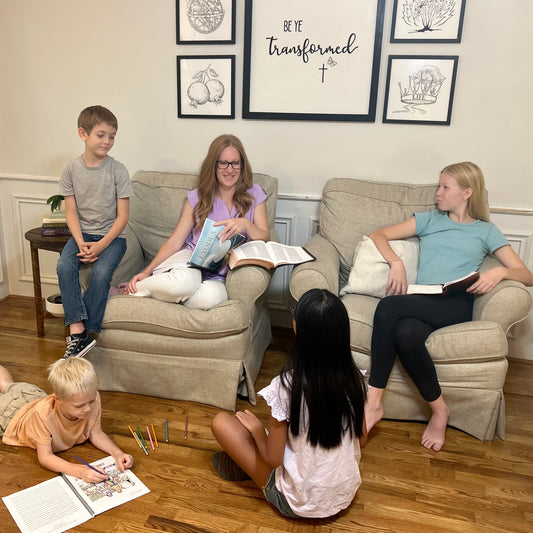
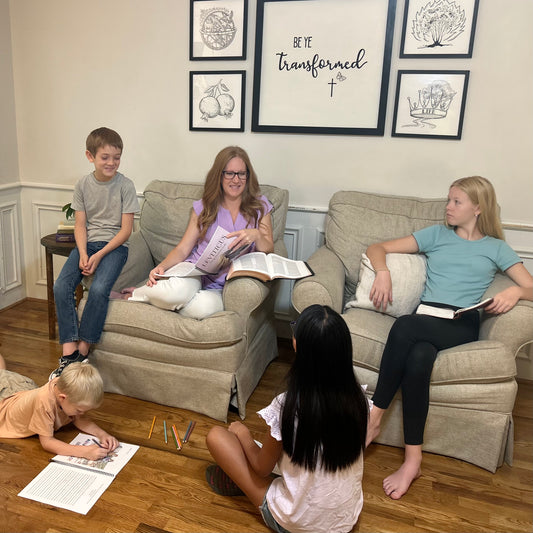
If you have a large family like mine (5 kids aged 6-15), you don’t necessarily have to wait for the youngest to hit 3rd or 4th grade—your teens would miss too much time! I started deep, discussion-based study with a homeschool Bible curriculum when my oldest kids were 8, 9, and 11. My littles played nearby, picking up tidbits here and there. My youngest is almost 7 now, and he’s fully participating in Bible study with the whole family. We were always in the room together, but now we’re all discussing together!
Ready to Go Deep with your 4th Grader?
By leaning into this unique developmental window, you aren't just teaching your kids facts about a book; you’re teaching them to use the critical thinking skills needed to own their faith for a lifetime. A great way to start the conversation is with our Genesis Discussion Guide. It doesn’t require any prep to discuss big topics as you talk through the Bible, chapter by chapter—just open and go!

Why start with Genesis?
It builds the foundation for everything that follows, and honestly, it’s a book that’s easy to get kids excited about. Our guide explores:
- Creation: How Genesis and science align
- The Flood: Which animals fit on the ark, how they were fed, and how the flood reshaped the earth
- The Tower of Babel: New languages, genetics, and how we look different but all come from one family—Noah's
- Abraham's Family: God's big promises that set the stage for the rest of the Bible
- The 12 Tribes: Including how Joseph ended up in Egypt to save them from starvation (with resources for a unit study on ancient Egypt)
Tackle Tough Questions Together
Our Genesis guide gives you the tools to discuss things kids (and adults!) wonder about, including:
- How do creation and science line up?
- Who did Cain marry, and was that okay?
- Did Abraham’s prayers actually change God’s mind?
- Why did God choose Jacob over Esau?
- Is sin part of God’s plan?
- If God is merciful, why do "innocent" people suffer?
- How far does God's sovereignty extend?
Each of our studies includes guided discussions through each chapter of the Bible, optional activities, and links to articles and books for when your kids want to dive deeper.

Grab our Genesis Discussion Guide and take advantage of your kids' developing critical thinking skills to help them discover God and build a faith that lasts a lifetime.
Still Researching?