Sequential vs Topical Bible Study for Kids & Teens
Imagine trying to build a lifelong relationship with a new friend by only reading a bulleted list of their personality traits.
You might memorize the list, but you don't actually know her. You can’t predict how she will react under pressure, you don’t understand her overarching motivations, and you certainly haven't developed a deep bond of trust with her.
True relationship requires watching a person’s character unfold through their actions, over time, across a cohesive narrative.
Yet, when it comes to teaching our tweens and teens about the character of God, the standard youth devotional uses the bulleted-list approach. On Monday, they read a few isolated verses stating that God is love. On Tuesday, a verse about His justice. On Wednesday, a verse about His peace.
While these attributes are true, this fragmented method creates a barrier to genuine relationship. You can never truly know a person by reading unconnected sentences about them. To know God's heart—and to trust His grand plan—your older kids need to watch His character unfold sequentially, chapter by chapter.

The Science of Character Attribution: Why Actions Speak Louder Than Attributes
In cognitive psychology, Attribution Theory explains how the human brain evaluates behavior to determine a person's true character. The brain is naturally skeptical of abstract labels; it demands empirical evidence. We do not fully believe someone is "faithful" until we observe them maintaining a commitment through complex, changing circumstances.
When teens only read curated topical verses, their brains are forced to process God's traits as abstract, isolated vocabulary words.
When you switch to sequential, expositional Bible study—moving through an entire book of the Bible in the order it was written—you activate the brain’s narrative processing networks. Human beings are neurologically wired to understand reality through stories, not topical data sheets.
- Observing the Pattern of Action: In a systematic study of Genesis, your tweens and teens don't just read the statement "God keeps His promises." They watch God make a covenant, see decades of human failure, witness Abraham's doubt, and then watch God fulfill His word anyway. The brain moves from tracking an abstract concept to witnessing a demonstrated reality.
- Contextualizing the Difficult Traits: When a teen reads an isolated verse about God’s wrath or judgment in a topical devotional, it can feel jarring, arbitrary, or cruel. But when they see that judgment arise sequentially after chapters of patient warnings, divine sorrow, and unceasing human rebellion, their logical minds process the true balance of God’s holiness and mercy.

The Heart Reasons: Seeing the Unfolding Plan
Beyond the cognitive science, studying Scripture chapter by chapter provides critical spiritual and emotional anchoring for kids ages 8–16.
1. It Builds Real, Unshakable Trust
In the adult world, your kids will face seasons of profound confusion where God’s plan feels invisible or painful. If their theological foundation is built on topical devotional quotes, their faith will struggle to find footing. But if they have tracked God chapter by chapter through the Old Testament, they know His historical track record. They've seen that God routinely works through delays, family dysfunction, and isolation to bring about redemption. They learn to trust the Author because they've studied the architecture of His stories.
2. It Protects Them from Creating a God in Their Own Image
Topical devotionals naturally favor human-centric themes: anxiety, self-esteem, friendship, and success. This trains teens to view God as a cosmic helper whose primary job is to fix their daily emotional struggles. Expositional study shifts the entire axis of family Bible time. When you open a book of the Bible and let the text dictate the conversation, your kids confront God on His terms, not theirs. They discover a majestic, holy, sovereign Creator who invites them into His grand narrative.
3. It Reveals the Golden Thread of Redemption
The Bible is not an anthology of independent moral fables; it's a single, unfolding historical epic. When you skip around topically, the grand arc is entirely lost. By studying sequentially, your middle and high schoolers begin to spot the brilliant structural unity of Scripture. They realize that a detail in Exodus or a covenant in Genesis isn’t random trivia—it’s a direct, intentional roadmap pointing straight to Jesus Christ.

Discover God’s Character Sequentially with Talk Through the Bible
Moving your family past the surface-level topical loop doesn't require hours of lesson prep or a library of theological commentaries.
Talk Through the Bible is an open-and-go, chapter-by-chapter discussion curriculum designed to let Scripture reveal itself naturally to your family.
- Socratic Framework: Our guides use in-depth, text-dependent discussion questions that compel your tweens and teens to look directly at Scripture, analyze God's actions, and discover His character.
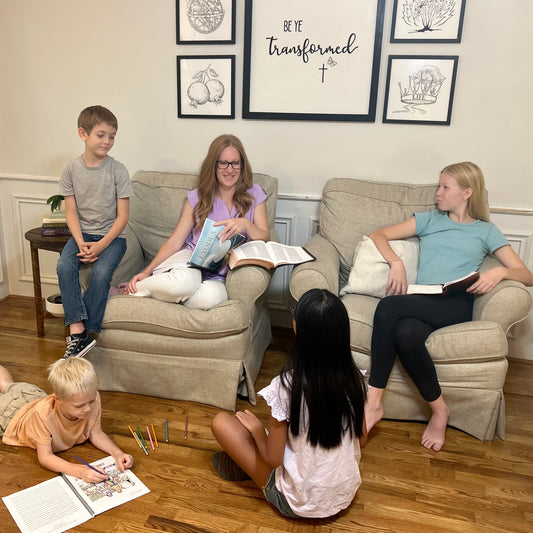
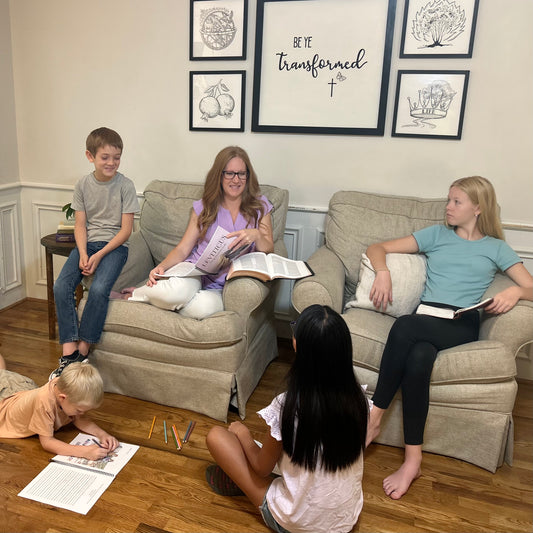
- One Deep Conversation for Ages 8–16: You don't need to purchase or manage separate Bible programs for different ages. Our discussion-driven model allows your entire family to gather around the exact same passage. Your 16-year-old can analyze the complex covenantal implications of the text, while your 9-year-old traces the direct narrative timeline. Everyone learns to think critically together.
- Zero Prep: You don’t need a theology degree to lead your children into deep biblical literacy. The historical realities, cultural contexts, and tracking prompts are already completely mapped out for you. You simply open the guide, read the Bible chapter together, and watch your kids discover the living character of God for themselves as you start asking questions.
Take your kids beyond surface-level, disconnected topical devotionals. Give your tweens and teens the ability to see the full, uninterrupted beauty of God's character and plan.
Explore our Pentateuch Discussion Guide, and start your family's zero-prep, expositional journey today.

Still Researching?