Expositional vs Topical Bible Study: The Science of Long-Term Memory for Teens
Ever sit down for family Bible time, read an encouraging devotional, check "Bible" off your homeschool list, and feel great—only to ask your 14-year-old about it at dinner and get a blank stare or generic one-word answer?
Don't panic or assume your kids are spiritually checked out. The reality has to do with cognitive science: your kids aren't retaining the information because standard topical devotionals are structurally designed to fail the human brain’s memory system.
The Illusion of Competence: Why Passive Reading Fails
To understand why traditional youth devotionals don't stick, you have to look at how the brain processes and retains information.
Most devotionals rely on passive consumption. A writer extracts a verse, synthesizes a modern application, packages it in a neat story, and hands it to the reader. Your teen's only job is to sit there, read it, and absorb it.
In educational psychology, this creates what is known as the illusion of competence. Because the devotional is easy to read and makes immediate sense, the student feels like they’ve learned something. But because their brain didn't have to expend any cognitive energy to work for the conclusion, the neural pathways required to build long-term memory were never activated.
The brain is a highly efficient organ; it ruthlessly purges information it deems low-priority. When knowledge is handed to a teenager on a silver platter, the brain categorizes it as passive background noise and drops it into the short-term memory trash can within hours.

The Power of Context: How Sequential Study Builds a Framework
There’s another massive flaw in standard topical youth devotionals: they’re completely fragmented. On Monday, your teen reads a verse from Philippians about anxiety. On Tuesday, they jump to a story about David and Goliath to talk about courage. On Wednesday, they skip to Proverbs to learn about friendships.
While these topics are important, this "hopscotch" approach to Scripture directly fights how the brain organizes information for long-term storage.
In cognitive psychology, memory relies heavily on schemas—interconnected mental frameworks that help us organize and interpret new information. Think of a schema as a mental coat rack. If you hand your teen a random jacket (an isolated topical verse) but they don’t have a coat rack to hang it on, it ends up on the floor, kicked to the corner, and forgotten.
When you study Scripture in order and let topics arise naturally, you’re building a permanent mental coat rack. Here is the science behind why this works:
- The Principle of Cognitive Anchoring: When a theological concept or moral lesson arises organically out of an ongoing historical narrative, the brain has an immediate anchor. Learning about God's faithfulness means infinitely more—and sticks longer—when it’s discovered right in the middle of Abraham’s decades-long wait for a son, rather than as a standalone quote on a pretty page.
- Webs of Retrieval vs. Isolated Facts: Long-term memory is associative. It is much easier to retrieve information when it is connected to a web of other known facts. By studying expositionally, your teen builds a chronological and thematic timeline. New insights automatically connect to what you discussed last week, creating a dense neural network of overlapping knowledge.
- Relevance Drives Attention: The human brain is a meaning-seeking machine. It filters out information that feels isolated or irrelevant. When a teen sees how a law in Leviticus directly sets up a story in Numbers, their brain registers a "lightbulb moment." That feeling of immediate relevance opens up cognitive pathways, signaling to the brain: This matters. Keep this.
By shifting to a sequential, expositional Bible study model, you stop expecting your kids to remember what the brain considers random, disconnected pieces of trivia. Instead, you give them a cohesive, narrative foundation where every new truth naturally locks into the ones that came before it.

The Science of Active Retrieval: Why Talking Beats Reading
If you want your tweens and teens to actually remember Scripture, you have to force their brains to shift from passive consumption to active retrieval.
Cognitive science has proven that long-term retention does not happen when you put information into a student's head; it happens when you force them to pull information out of their head. This is known as the testing effect or retrieval practice.
When a student has to process raw data, formulate a thought, and articulate an answer out loud, their brain has to physically build and strengthen neural pathways.
This is exactly why an expositional, discussion-based Bible study is scientifically superior to a passive topical devotional. It completely alters the cognitive workload:
- It Demands High-Level Processing: Instead of reading a summary of Joseph’s life, an expositional study asks them to look at the text and analyze why the historical backdrop of Egypt matters. Their brain is suddenly forced to connect historical dots, shifting the information from short-term memory to their long-term schema.
- It Capitalizes on Verbalization: When a teenager explains a theological concept in their own words during a family discussion, they are executing the highest form of cognitive mastery. If they can articulate it out loud to you at the table, they actually own the knowledge.
- It Moves Past the Surface Loop: Topical devotionals keep kids trapped in a repetitive loop of basic moral platitudes ("be nice," "don't worry"). Because the brain already knows these concepts, it tunes out. Expositional study introduces structural, historical, and text-dependent complexities that force the teen brain to perk up and pay attention to the novelty of deep truth.

Leverage Cognitive Science with Talk Through the Bible Homeschool Curriculum
Switching from a passive devotional to an active, expositional framework requires less work than you may think. In fact, it takes zero prep work!
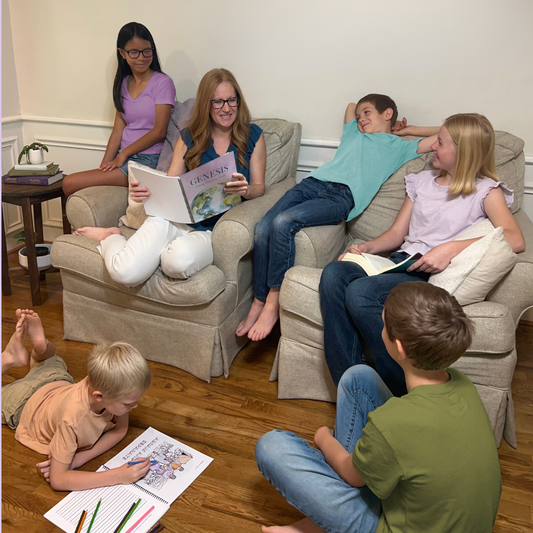
Talk Through the Bible is a discussion-based, chapter-by-chapter, open-and-go Bible curriculum specifically designed to deliver the high-retention benefits of active retrieval without you having to read ahead, browse commentaries, or study cultures and maps.
- Socratic Discussion, Zero Busywork: We completely ditch the passive fill-in-the-blank workbooks that kids can complete on autopilot. Our guides use targeted, sequential discussion prompts that force your tweens and teens to look directly at Scripture, analyze the data, and defend their conclusions out loud.
- For the Whole Family (Ages 8–16): You don't need to run separate tracks for each child. Because our guides are entirely discussion-based, your whole family studies the exact same passage together. Your 16-year-old can wrestle with complex covenantal theology while your 9-year-old targets more direct textual observations. Kids aren’t just learning at their own level; they’re leveling up by learning from each other.
- Zero Prep: You don’t need to be a theologian or a cognitive scientist to lead this. The historical context, textual pointers, and discovery-based discussion questions are fully laid out for you. You simply open the guide, read the Bible chapter, and let the conversation naturally lock the truth into your kids' long-term memory.
Don’t waste time on passive devotionals that fade by lunchtime. Give your tweens and teens an expositional framework that respects their intellect and sticks with them for life.
Explore our Discussion Guides and experience the power of zero-prep, high-retention Bible study today.

Still Researching?
- Why Teens Leave the Church & Using Cognitive Development Theory to Prevent It
- How Sequential Study Best Reveals God's Character
- Is Exegetical Study Right for My Family
- Which Homeschool Bible Curriculum is Right for Me? Top Brands Compared
-
Bible Study to Fit Your Homeschool Style