Ruth: A Family Bible Study Discussion Guide
Couldn't load pickup availability
Theologically Deep. Expertly Scripted. Zero Prep.
Don’t settle for surface-level devotionals. Written by a former educator and professor, this Ruth Bible study guides your family past the basic story into the deep waters of theology. Together, you'll unpack God's sovereignty, providence, and permissive will, discovering how those work together alongside our human choices to fulfill God's unchanging plan.
With the research and planning done, you can confidently lead in-depth discussions through the book of Ruth.
No-prep Homeschool Bible Study for Ages 8-16:
- Designed for family use together: upper elementary, tweens, & teens
- Open-and-go
- 20-30 minute lesson for each chapter of Ruth
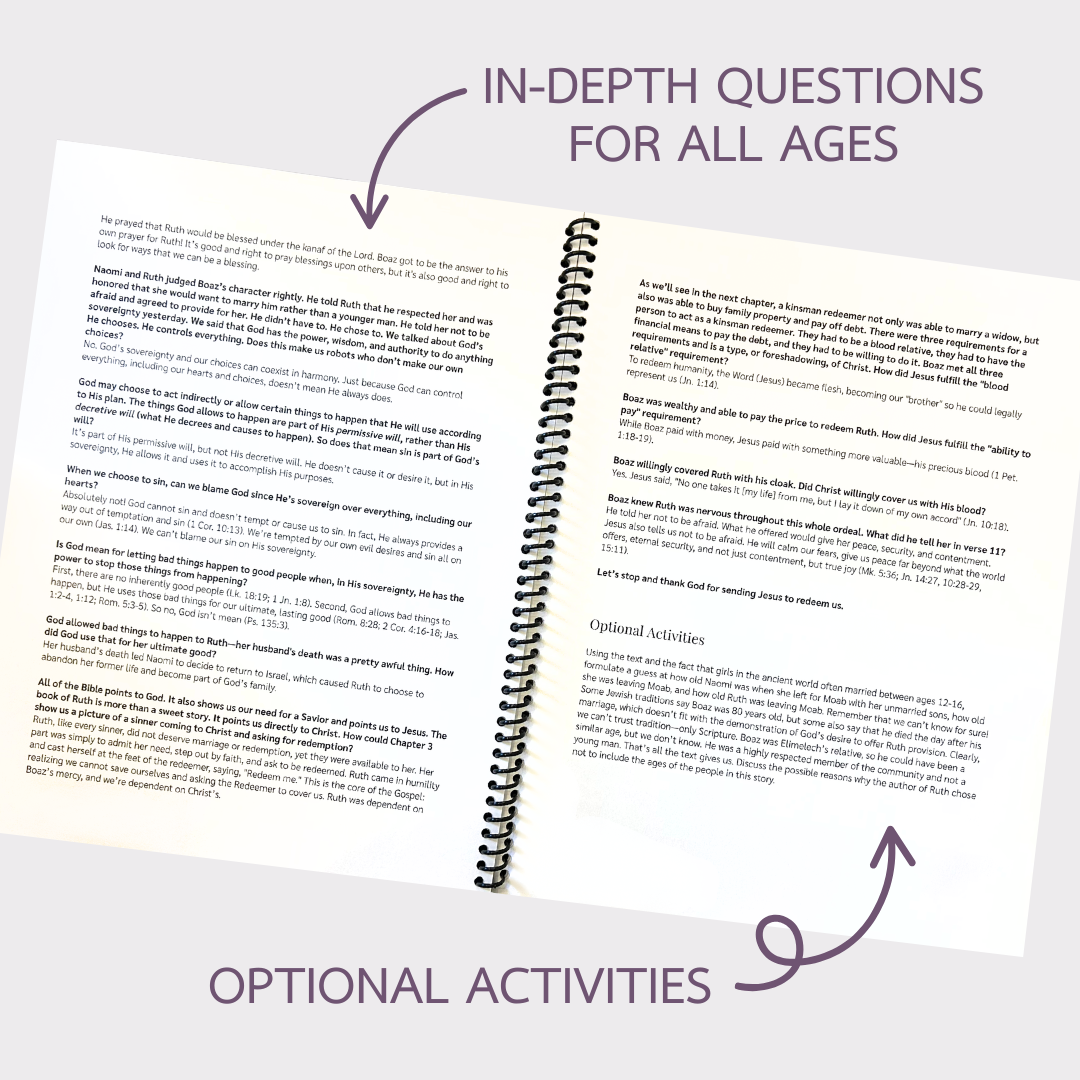
- High-level discussions encouraging critical thinking and discovery
- Can be used as a script or as a starting point for your own conversations
- Links to optional activities
- Perfect for Year 1: Ancient History homeschool families (1150BC-1000BC)
- Spiral-bound curriculum printed on thick matte paper with a gloss cover or a digital download

Big Questions and Apologetics for Tweens & Teens in Ruth:
- Why do bad things happen to "good" people?
- Is sin part of God's plan?
- Why should we pray if God doesn't change His mind?
- If God is sovereign over everything, including people, are we like robots?
- Does God really do everything for our good and His glory?
- What is the difference between God's permissive and decretive will?
- Why are certain details left out of Scripture?
- How does looking at the Hebrew help us better understand Scripture?
- How does Boaz specifically point us to Christ?

Building Critical Thinking & Biblical Worldview
While most resources focus on "what" to believe, our Bible studies focus on "why" we believe. Developmental research confirms that at ages 8-9, children begin to analyze and think critically about their faith. Because worldviews are often permanently solidified by age 16, this Bible study empowers you to capitalize on this crucial stage. By scaling the complexity, you can include your 8-year-old in the dialogue while your tweens or teens provide the momentum. Together, your family will use logic and reasoning to build a solid foundation of faith, theology, and doctrine for all of your children together.
Why it Works: Socratic Questioning
Using Socratic-style questioning, you won't just tell your kids what to believe—you’ll lead them to discover the character of God for themselves. This isn't a lecture; it's a conversation. You’ll start by reading Scripture (we don’t leave anything out), then go from observation to discussing how the Bible shapes our worldview.

Why Making Time for Discussion is Worth It
- Your kids will see you get excited about the Word, and excitement is contagious!
- You can guide your children into what you believe the Bible teaches rather than hoping someone else gets it right.
- By tackling the challenging parts of the Bible together with your kids, they'll be prepared when the world questions their faith.
- Discussions develop a much deeper understanding of Scripture through active processing, multiple perspectives, critical thinking, and connections to experiences and other subjects.
- Studies show we remember 7x's more of what we discuss than what we read!
Equip Your Children to Own Their Faith with Talk Through the Bible
By the time they reach a secular university or a skeptical culture, they won't just have answers—they’ll have an intellectually grounded faith and a heart that is truly in love with God.
Get your digital or printed Ruth Bible study today!

FAQ's
What ages are Talk Through the Bible discussion guides written for?
Our guides are primarily written for students aged 7 to 16. However, while children aged 7-8 can definitely participate and benefit from the content, they often struggle to anchor the dialogue if they're the oldest in the group. This curriculum is designed for multi-age families and groups with an older child (10+). Families and groups with only children aged 9 and under may find the discussions more challenging to maintain without an older child to bridge the gap between the adult's questions and the younger students' observations.
What do you believe?
The beautiful thing about discussions is that you're in control. I strongly believe that there's something to learn from everyone, but I wouldn't teach my kids from a Bible curriculum built on a foundation I didn't agree with. Here's what I believe:
-The Bible was written by men inspired by God and is wholly true and trustworthy. It’s the supreme authority in faith, doctrine, and practice. Unless a passage is clearly intended by the author to be read as an allegory, poetry, parable, or prophecy, the Bible should be interpreted literally. Creation, the flood, genealogies, narrative accounts of the Israelites, and miracles are to be read literally.
-There is one living and true God whom we know in the persons of the Father, Son, and Spirit.
-God is the creator of the universe and is sovereign over all. He is perfect, good, and worthy of all honor. He has a plan for everything, and nothing will stop Him from working it out.
-Christ, the Son, took on human likeness and was born of a virgin, lived a perfect life, and died a substitutionary death for those the Father gave Him. He was raised from the dead and is seated at the right hand of God, acting as our Mediator. He will come again in glory to judge the living and the dead.
-The Holy Spirit testifies to Christ. He indwells believers, guiding them in sanctification and marking them with a seal of salvation.
-All men are totally sinful and in need of the Savior. Salvation can't be earned. It comes by grace through faith, and it is a gift of God.
-It is the privilege and responsibility of all believers to preach the gospel and make disciples, starting at home. Children are a blessing from the Lord. They should be taught God's truth through words and actions. They're never too young to learn about God!
What denomination is Talk Through the Bible?
Talk Through the Bible is not affiliated with a particular Christian denomination. Our discussion guides aim to help you explain Christian doctrines to your children as you study through the Bible and various topics arise.
Do I need a particular version of the Bible?
No. The ESV is primarily used in our studies. Other translations are occasionally referenced for specific verses. However, you and your children will be reading out of your own Bibles. You can easily use your preferred translation for any of our studies.
Can this be used as a homeschool Bible credit?
Absolutely! As the teacher, you choose what your students receive credit for. The Pentateuch is a full-credit, one-year Bible curriculum with 31 weeks of lessons. If you want more structured teaching time, you can also include an Advent study, download our free Holy Week discussion guide, or complete the Israelites' journey into the Promised Land with our 4-week Joshua discussion guide. All of our discussion guides include links to additional reading and optional activities if you want your students to do more to earn their credit based on age. If you're looking for a half-credit course, you can combine any of our Bible studies.
Can I use these discussion guides to lead Sunday School?
Yes! They're open-and-go, so they're convenient even when teachers have to rotate or need a substitute. The lessons can be completed in about 35-45 minutes, depending on the number of students and how quickly you push the discussion forward. I love discussion-based classes because the students get to know each other and form friendships, they ask questions, they learn what they're interested in because it's ok to go "off topic," and they make connections with the sermons. My church uses the Genesis guide to build a foundation in the 4th-6th grade discipleship class, but these guides can easily be used as in-depth Bible studies all the way through high school.