Why Middle Schoolers Need Read-Alouds
There's a bittersweet milestone that happens in every homeschool journey. It’s the day your child transitions from sitting in your lap mispronouncing words to reading fluently, silently, and entirely on their own.
As parents, our default reaction is to celebrate. We think, “Mission accomplished. They can read independently now. I can hand them books and step back.”
We close the chapter on family read-alouds.
But according to both cognitive neuroscience and developmental psychology, stopping read-alouds when children become independent readers is one of the biggest missed opportunities in homeschooling.
Your older kids—fluent readers in their tween and teen years—still need to hear your voice. The comfort and connection of reading aloud don't expire at age eight. In fact, some of the most profound neurological, developmental, and relational shifts only happen when you keep reading to them long after they can read for themselves.
The Listening Level Gap
In educational psychology, there's a well-documented phenomenon known as the listening level gap. A child’s reading level (the complexity of text they can decode on a page by themselves) does not catch up to their listening level (the complexity of language, vocabulary, and syntax they can comprehend when hearing it spoken) until around eighth grade.
When you read aloud to an 11 or 14-year-old, you aren't babying them—you're stepping into that cognitive gap. Here's the beautiful science of what's happening inside an older kid's brain when they get to sit back and listen to you read:
- Auditory Synaptic Mapping: Hearing complex sentence structures and advanced vocabulary read with proper vocal inflection maps neural pathways that silent reading can't replicate. They absorb the rhythm of high-level language, which improves their own speaking skills.
- Cognitive Offloading: When an older child reads complex material silently, a massive amount of their cognitive energy is spent on the mechanics of decoding, tracking, and pacing. When you read aloud, you handle that for them. This frees up their working memory to focus on deep comprehension, critical thinking, and abstract themes.
- Analytical Discussion: Because their brains aren't exhausted, they're ready and able to talk about what they're hearing. The door is open to natural discussions where you can challenge assumptions and help kids articulate complex thoughts.
Relational Benefits of Reading Aloud
Beyond the cognitive science, continuing to read aloud to older kids serves a critical developmental and emotional purpose during the transition into adolescence.
- Co-Regulation & Bonding: The tween and teen years bring a neurological rewiring that can leave kids feeling overwhelmed, defensive, or emotionally distant. Reading aloud triggers the release of oxytocin (the bonding hormone) and lowers cortisol (stress) levels in both the reader and the listener. It acts as a physiological anchor. Sitting together in a shared space, listening to the familiar cadence of your voice, forces a physical and mental slow-down. It creates a safe, no-pressure environment where connection happens naturally.
- A Shared Experience: When a family shares a story out loud, they build a shared cultural vocabulary. The characters' choices, trials, and triumphs become a reference point for your family's real life. It allows you to discuss heavy concepts—justice, betrayal, integrity, sacrifice—through the safe lens of text. You can guide their moral reasoning and worldviews organically, questioning the text together with them rather than lecturing at them.
The Ultimate Read-Aloud: The Word of God
If reading aloud secular literature and history yields such profound cognitive and relational fruit, how much more can be gained from reading the living text of Scripture aloud?
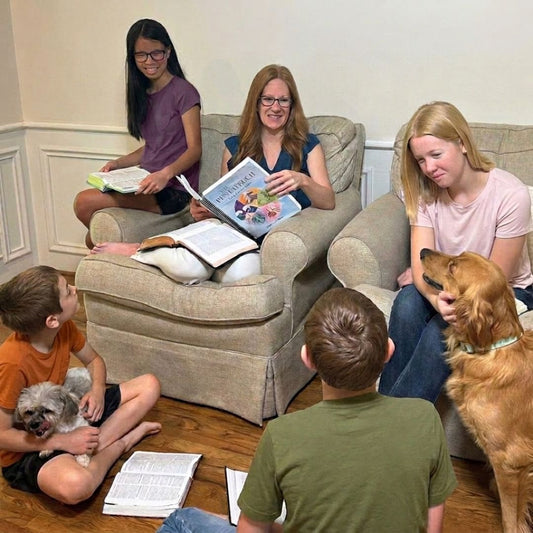
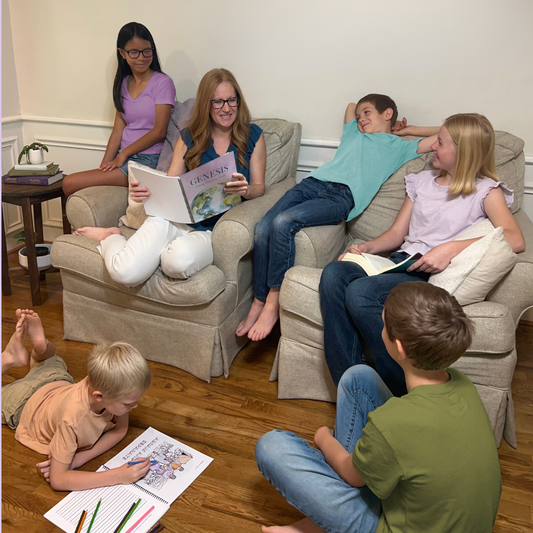
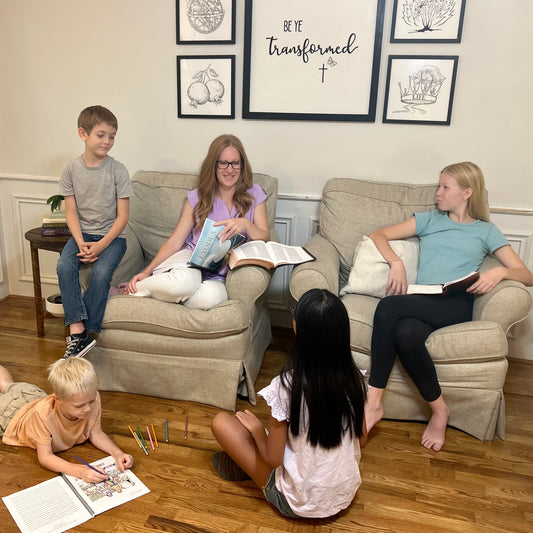
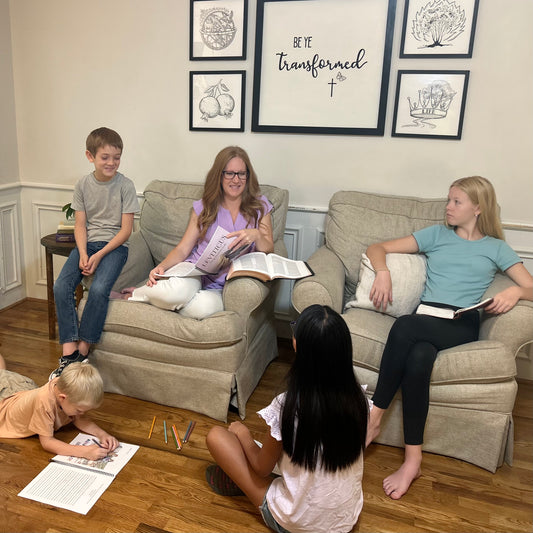
The Bible was never meant to be an isolated, individual workbook assignment that we hand to our older kids to check off a list alone in their bedrooms. Historically, Scripture was written to be proclaimed out loud to intergenerational communities (to families!) gathering together.
When you gather your fluent readers, your skeptical middle schoolers, and your analytical teens to read the Bible aloud as a family, the dynamic shifts:
- It Levels the Playing Field: In a family with varying reading abilities, reading Scripture aloud removes the barrier of vocabulary frustration. Your 9-year-old and your 16-year-old are exposed to the complex, unfiltered text of God's Word together, sharing the same foundation.
- It Sparks Deep Discussion: Reading the Bible aloud together naturally opens the door for real conversation. It allows you to pause and ask the logical questions that force their growing minds to analyze God's character, connect historical dots, and articulate their developing faith.
Don’t relegate the power of your voice and time to the early childhood years. Your tweens and teens still need you to lead the narrative. Gather them back to the table, open the text, and let the habit of reading aloud anchor their minds and hearts for life.

Build Scriptural Literacy with Talk Through the Bible
If you want to transition your family from isolated Bible reading into a rich read-aloud culture, Talk Through the Bible is everything you need.
Our open-and-go discussion guides require absolutely zero prep. Designed specifically for families with kids ages 8 to 16, our curriculum combines the power of communal Scripture reading with in-depth, Socratic discussion prompts. You simply read the Bible chapter aloud together and let the questions guide your kids into deep biblical literacy and unshakeable faith based not just on the "what" of Scripture but also on the "why" of Scripture.

Explore our Pentateuch Discussion Guide to guide your read-aloud Bible time today.