A Christian Professor's Plea to 4-10th Grade Moms
After years in higher education, I learned a hard truth that most youth ministries and Christian families miss: College professors don't destroy a student's faith. They merely expose a foundation that was already hollow.
The "deconstruction" crisis we see hitting young adults doesn't start in a university lecture hall. It starts years earlier at home, when we give young minds emotional, fragmented theology and expect it to withstand a rigorous adult world.
What I Saw as a Student: The Quiet Drift
When I arrived on campus as a freshman, I immediately looked for community and joined the Baptist Campus Ministries (BCM). I made a wonderful circle of friends right away, many of whom I’m still friends with 25 years later. These were all kids who, like me, had grown up in church, attended youth groups, and knew all the right answers there.
But by sophomore year, a heartbreaking pattern emerged as several of my friends quietly dropped out. They were good, moral kids who seemed to love God, but their faith was built on emotional highs, camp experiences, and a handful of isolated topical verses meant to fix their daily worries.
For a few of them, it took only one skeptical professor or challenger in a lecture hall to collapse their faith. Because they’d never wrestled with the complexity of Scripture at home, they lacked logical and intellectual reasons for what they believed. The professors, on the other hand, had highly sophisticated arguments for believing the opposite—and those arguments sounded incredibly convincing compared to absolute silence.
But for the vast majority of my friends who walked away, there was no dramatic intellectual battle. They quietly drifted away because their faith had never actually become theirs. It was an inherited family tradition, wrapped up in a comfortable Southern cultural identity. Their biblical knowledge was a disjointed collection of moral lessons and childhood Bible hero stories. When they left home, that cultural veneer wasn't real enough or deep enough to matter anymore, so they just let it drop.
What I Saw as a Professor: The Superficial Foundation
Years later, I returned to my alma mater, but this time I stood behind the podium teaching Spanish. While I wasn't grading theological research papers, my vantage point on student culture was unhindered.
During my office hours and while listening to the chatter of freshmen packing up their backpacks after class, I heard the reality of their worldviews.
These students were bright, capable, and striving to transition into adulthood. But when they talked about life, morality, and their futures, it became glaringly obvious that their faith was completely compartmentalized. It was treated as a sweet childhood memory that had no bearing on how they processed logic, culture, or real-world decisions. Because the Christian education of their youth had never connected Scripture to the real world and their actual thinking, they had no internal defense system against the secular narratives moving through the campus.
The Antidote: Intellectual Immunization at Home
If we want our homeschooled kids to possess an unshakeable faith when they step into adulthood, we have to change how we teach them Scripture in middle and high school. We have to stop feeding them intellectual milk when their developing minds are desperate for meat.
True biblical literacy acts as an intellectual immunization. You don't protect your kids from the hard questions by avoiding them; you immunize them by deliberately introducing those questions at the kitchen table, helping them discover the answers they need.
When you shift from passive, topical devotionals to a sequential, chapter-by-chapter study of the unedited text of Scripture, you completely re-engineer their foundation:
- Exposition Over Fragmentation: By studying books of the Bible expositionally, kids see that the biblical narrative isn't a collection of disconnected fairy tales with a moral lesson attached. They encounter a holy, sovereign God working through flawed people across centuries of actual history.
- Formation of a Personal Worldview: When students track God's character chapter by chapter, theology stops being their parents' rules and becomes their own logical lens for evaluating reality.
- Proactive Intellectual Reconciliation: Instead of being shocked by a difficult text in a college classroom, they wrestle with it at breakfast. They learn how historical context anchors theology, building the mental muscles needed to articulate their convictions out loud.
Don’t fear the secular professors or the shifting culture. Instead, give your kids a framework that respects their intellect and anchors their logic in the full, uninterrupted beauty of God's Word.

Build an Unshakeable Foundation with Talk Through the Bible
You don’t need a theology degree to give your tweens and teens an academically rigorous biblical foundation.
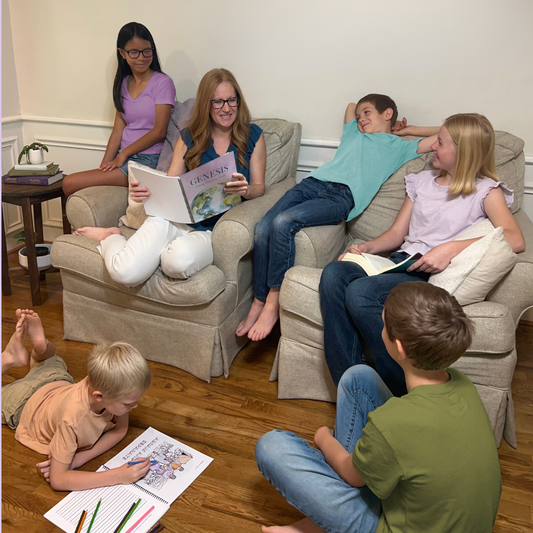
Talk Through the Bible is an open-and-go, chapter-by-chapter discussion curriculum engineered specifically to engage the analytical minds of older kids (ages 8–16) with zero parental prep required.
Our guides completely reject passive fill-in-the-blank worksheets. Instead, they use high-capacity, Socratic discussion prompts that compel your kids to look directly at the primary source, analyze God's actions, and articulate their faith in their own words. We walk families through all of the challenging topics kids face when they leave home—how science and creation align, why bad things happen to “good” people, whether sin is part of God’s plan, God’s sovereignty vs free will, whether miracles are real, and more.